



Your Healthcare GTM Plan Has Too Many Priorities. How to Choose What Comes First.
A healthcare company can have several credible paths to growth and still need to choose one to lead with.
There are existing customers to expand, a new market to enter, partnerships to explore and a bigger story to tell investors. Each opportunity deserves attention. Put all of them into the same near-term marketing plan, though, and the team can end up producing a lot without making enough progress on any one of them.
The answer is to make the choices underneath the plan explicit: what the business needs next, which buyers can help it get there, and what has to happen before those buyers can act.
Start with the business milestone
“Build awareness” does not give a team enough direction to decide what to do on Monday. Neither does “generate more leads.” Before choosing channels or campaigns, agree on the business milestone marketing needs to support.
That could be creating qualified opportunities in an established segment, helping a new offering earn its first customers, expanding relationships within existing accounts, or equipping the commercial team to enter a different market. Those goals require different work and different evidence of progress.
Be specific about the time horizon, too. A plan for this quarter should reflect what buyers can realistically do in that period. A longer-term market-building effort can run alongside it, with its own expectations and investment.
Write the goal as a decision: “For the next planning period, our primary commercial priority is ___, because it helps us reach ___.” If leadership cannot finish that sentence consistently, a channel calendar will not resolve the disagreement.
Start with the next business milestone. Then decide which buyers and work can help you reach it.
Separate the markets you could serve from the buyers you can win
A large addressable market can be useful context. It is a poor substitute for a target-account strategy.
For each potential segment, ask who experiences the problem, who controls the budget, who can authorize a purchase and who has to make implementation work. Sometimes those responsibilities sit close together. Sometimes they sit in different departments with different incentives.
Then consider access. Do you have credible relationships, relevant proof and a way to reach the people involved? Is there a reason for them to reconsider their current approach? Can your team support the sale and delivery?
For example, imagine a healthcare technology business considering both independent practices and large provider organizations. Both may have a use for the product. The purchasing process, evidence requirements and implementation effort may differ enough that each needs a distinct commercial plan. Treating them as one audience can obscure what is actually required to win either.
Our broader guide to healthcare marketing explains why understanding the decision-maker matters. Prioritization takes that understanding further: which buying path deserves your next investment?
Once you have chosen the right accounts, use our guide to building an account-based outreach campaign to connect that focus to execution.
Compare opportunities against the same questions
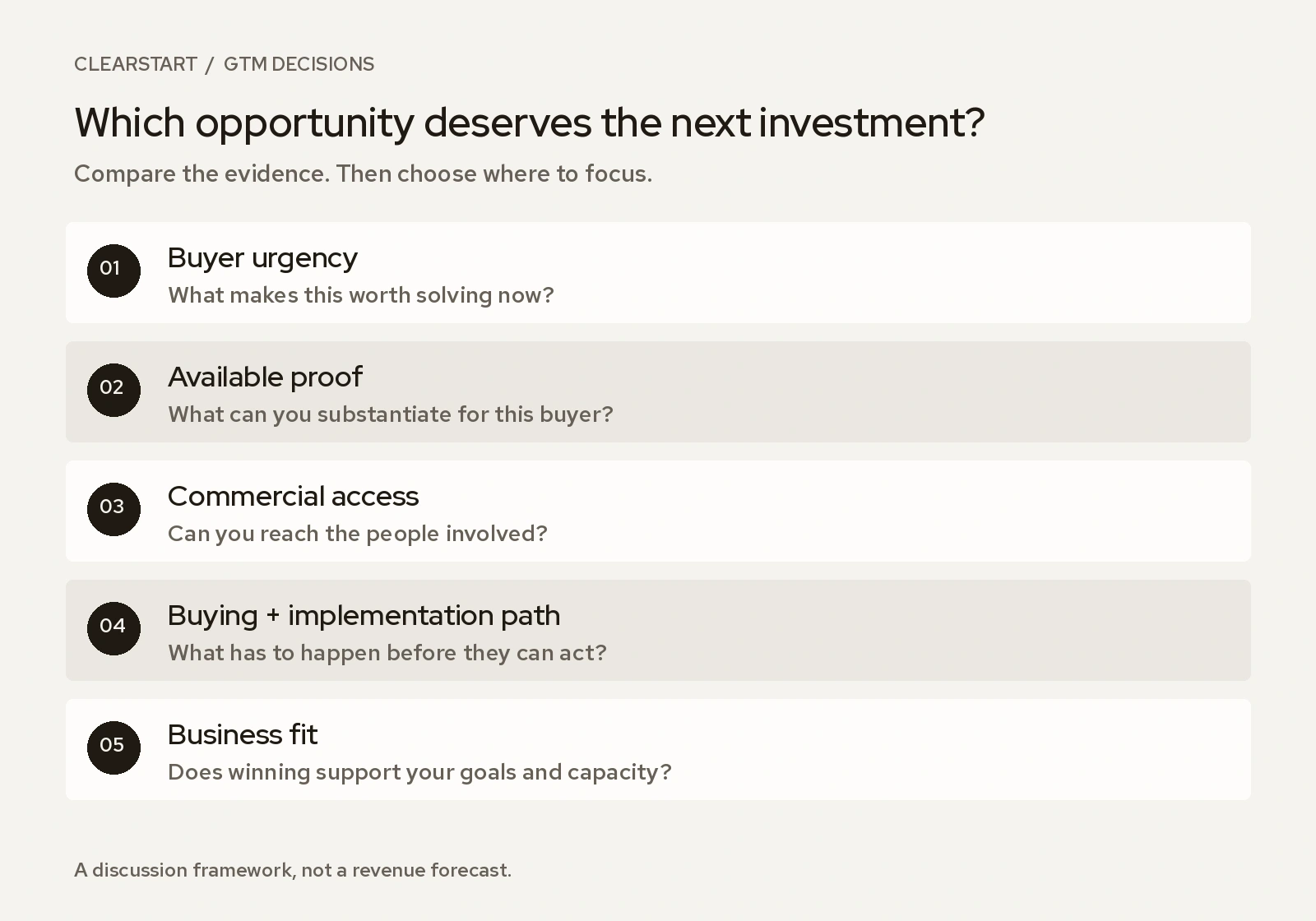
Teams often compare one opportunity’s future potential with another opportunity’s current limitations. Give every option the same test.
- Buyer urgency: What makes this problem worth addressing now? Look for a concrete trigger, constraint or active initiative.
- Available proof: What can you substantiate for this buyer today? Identify the relevant evidence and the gaps that remain.
- Commercial access: Who can open the conversation, and how will you reach the rest of the people involved?
- Buying and implementation path: What decisions, resources and dependencies stand between interest and a working customer relationship?
- Business fit: Would winning these customers support your goals, economics and delivery capacity?
Document the evidence beside each answer. A simple strong/mixed/weak assessment can help organize the discussion, but the explanation matters more than the rating. “Strong buyer urgency because an approved initiative needs a solution” is more useful than a number with no basis behind it.
Use the comparison to choose where to concentrate effort and what to investigate next. Do not treat it as a precise revenue forecast.
Put the comparison to work. Use the free Buyer and Market Prioritization Workbook to map up to three opportunities, compare the evidence and choose a primary focus with your team.
Give current opportunities and future opportunities different jobs
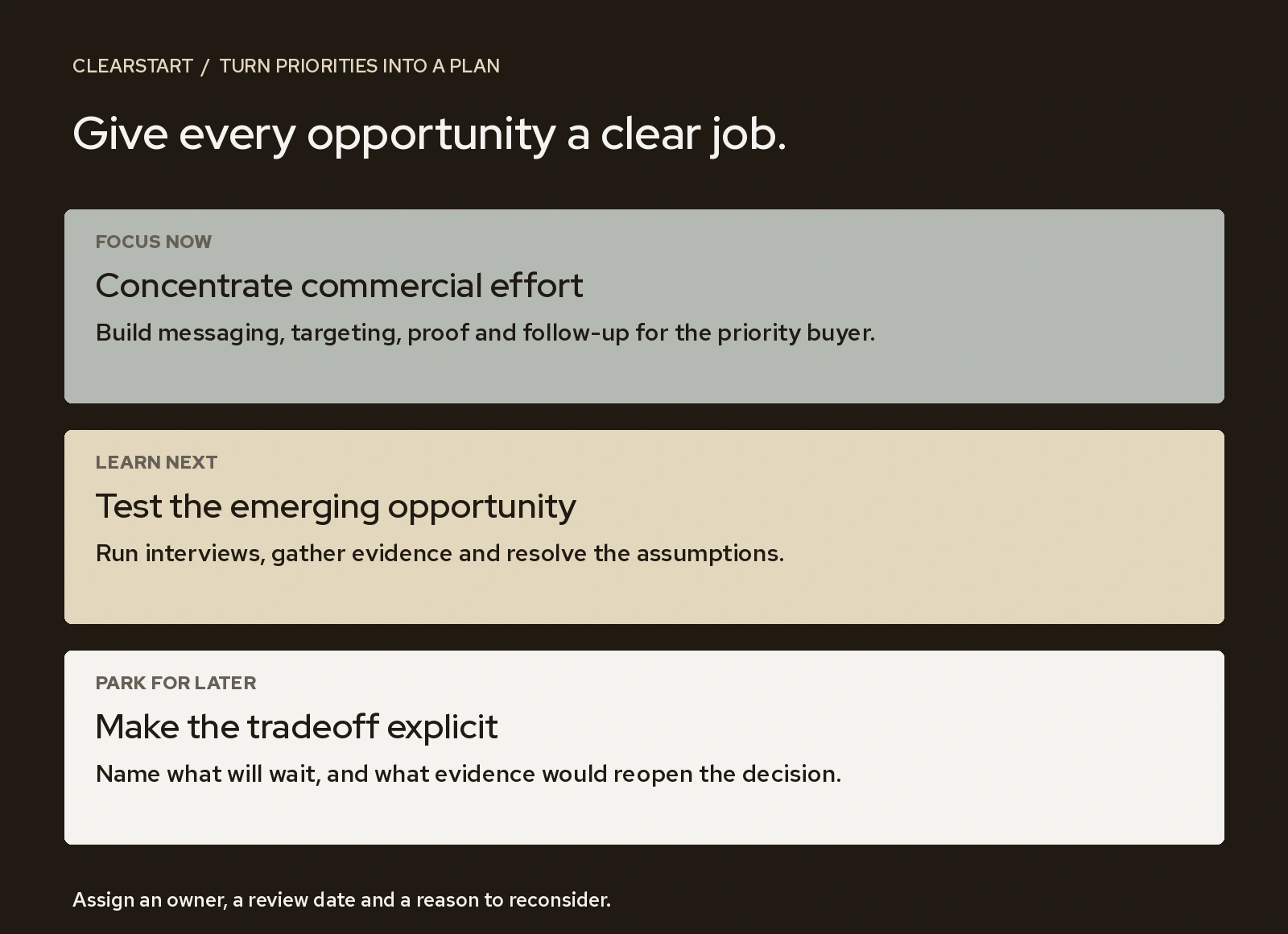
Some opportunities are ready for a focused commercial push. Others need research, relationships, proof or product development before they warrant that level of investment.
Your plan should make that distinction visible. For the primary near-term opportunity, build the messaging, account targeting, sales materials and follow-up needed to move specific buyers forward. For an emerging opportunity, define a smaller learning agenda: interviews to conduct, assumptions to test, evidence to gather or partnerships to explore.
This also helps keep the story credible. Describe what the business can deliver today clearly. Explain future ambitions with language that preserves their actual status. A compelling vision should help a buyer understand your direction without creating confusion about what they can buy now.
Connect the marketing work to the next buying decision
Once the priority is clear, the marketing plan becomes easier to judge.
If the right accounts are unfamiliar with the business, targeted visibility and relevant educational content may matter. If conversations are happening but buyers struggle to explain the value internally, the more useful work may be a clearer business case, stronger proof or materials that help a champion involve colleagues.
If opportunities keep stalling around implementation, investigate the unanswered questions: ownership, workflow changes, resources or the steps required to get started. More attention at the top of the funnel will not resolve those questions on its own.
Every major deliverable should have a job in that buying process. Ask: Who is this for? What do they need to understand or decide? What should happen next? If the answer is vague, tighten the brief before making the asset.
For a public example of connecting positioning to the commercial motion, see how we helped Medisafe reposition for enterprise pharma buyers.
Make the tradeoffs visible
A useful plan names what will receive concentrated effort, what will receive limited exploratory work and what will wait. Assign an owner and a review point to each.
Choose evidence that could change the decision. That might include qualified buyer conversations, repeated objections, implementation requirements, opportunity progression or findings from customer interviews. Review what you learned against the assumptions that led you to prioritize the segment.
This gives the team a way to adapt without chasing every new conversation. A promising opportunity can earn more investment when the evidence supports it.
The most useful healthcare GTM plan makes it clear why the work belongs in the plan and how it helps the business reach its next milestone.
Turn the decision into a working plan
Get the free Buyer and Market Prioritization Workbook for fillable worksheets, a worked example and a 30-day learning plan. It gives your team a practical place to make these choices and revisit them.
Working through competing growth priorities? Talk with Clearstart about what should come first. We connect strategy, marketing, brand and web around what the business needs to move forward.

